Posts

Image
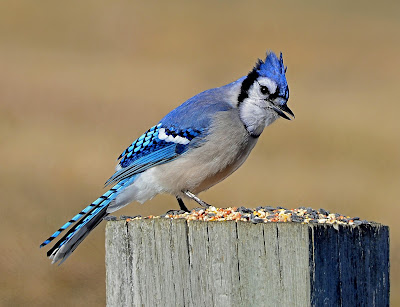
Nature News: Blue jays are an oak's best friend Acorn-hoarding by blue jays is important to the spread of oak forests  throughout the northeast                         photo by Rodney Campbell When I mentioned to a friend that I was writing about blue jays, she told me that for the longest time she had a negative opinion of them. She equated blue jays with pigeons and starlings - pesky, noisy, messy eaters, bullies at bird feeders. However, after moving away from New England, she found she missed them - their uncommon good looks, their role as sentinels of the forest and the birdfeeder, their inquisitive natures. Blue jays are corvids, close cousins of the crows, ravens and magpies. Like crows, they are known for their intelligence and while they've never been observed using tools in the wild, according to the Cornell Lab of Ornithology, captive blue jays have used newspaper strips to rake food pellets into c...
Image
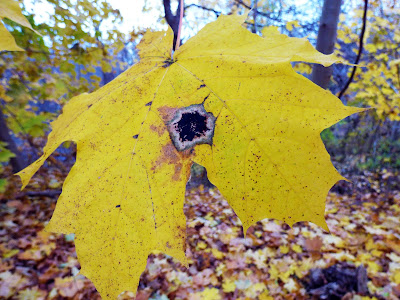
Nature News: Tar spot fungus showing up on maple leaves By  Sue Pike yorkweekly@seacoastonline.com/The York Weekly/Portsmouth Herald/Exeter Weekly/Fosters Dailly Democrat Tar spot on sugar maple leaf                        photo by Sue Pike There are mushrooms and then there are fungi, essentially the same thing (mushrooms are the reproductive parts of fungi), but while we humans think mushrooms are cute and give them fanciful names like toadstools or pixie rings, a large number of fungi go unnoticed or unrecognized. Or even worse (if you are a fungi who takes umbrage at human misunderstandings) many fungi are considered to be diseases. Athlete’s foot for example - a fungi just trying to survive on human feet. Or the tar spot fungus that is showing up on many of the brilliant yellow maple leaves this fall. Most of the sugar maple leaves in my neighborhood are dotted with these tar spots; my neighbors were ...
Image
Nature News: Red squirrels love to stash away pine cones By  Susan Pike  published the week of Nov 14 2016 in a variety of local newspapers I was out hiking with a friend when a red squirrel accosted us on the trail, clearly wanting something to eat. It sat up on a rock, its tail quivering, it jumped down and moved closer.  I took out my phone and snapped some photos before disappointing it and walking away.  A red squirrel hoping for a bit of food to be tossed its way  by Sue Pike I feel like I’ve known red squirrels my entire life. They lived in the big spruce trees behind my childhood house and left little piles of picked-over pine cones among the mossy stumps. When I was little, my father would read to us from the Burgess Animal Book. What I remember most about that book is a random line: “Chatterer the Red Squirrel had been scolding because there was no excitement.” This character - Chatterer - was always getting into trouble with Old Mother...
Image
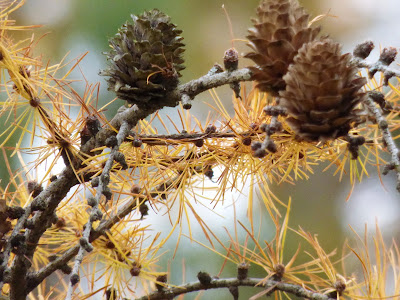
Tamaracks are rebels in the tree world By  Sue Pike  yorkweekly@seacoastonline.com and local papers  November 7, 2016 Tamarack with fragile needles and upright cones by Sue Pike I drove out to Cooperstown, N.Y., to visit my son this weekend. It was beautiful driving through the Berkshires into northern New York. The trees were mostly bare except for brilliant stands of red maple and deep orange oak and then, every once in a while, blazes of almost fluorescent yellow tamarack. Tamaracks are rebels in the tree world. We all easily categorize trees as either evergreen or deciduous. The evergreens are mostly conifers; needle-leaved, cone-bearing trees like pines, firs and hemlocks. The deciduous trees are the ones that draw the leaf peepers to New England - scarlet maples, orange and brown oaks, yellow birches, beech and poplar; broad-leaved trees that turn color and then drop their leaves in winter. Tamaracks are nonconformists to this dichotomy because they ar...
Image
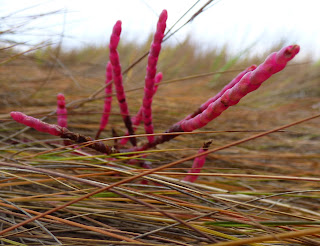
Nature News: Sea pickle thrives in salt marsh By  Susan Pike Late season sea pickles are brilliant red against the salt hay I live just down the road from a salt marsh. The salt marsh hay is yellowish brown now and lying over in those distinctive cowlicks. Walking on it, I always feel like a flea walking on the back of a dog. Here and there bright red sea pickles poke through, adding some lively color to an otherwise monochrome scene. I learned about sea pickles when I first moved to Maine. My kids and I liked to eat them (they taste like tiny pickles) during our ramblings through the marsh. While working at the Wells National Estuarine Reserve, I discovered their importance as a salt marsh indicator species. Sea pickles (also called glasswort, samphire, saltwort, or, scientifically, as Salicornia species) and Spartina grasses (salt marsh hay and cord grass) are the most common salt marsh plants and have worldwide distributions. These plants are halophytes (plants ad...
Image
Blue Mussels in Decline by Sue Pike October 15 2016  The York Weekly/York County Coast Star/Portsmouth Herald/Fosters Daily/Exeter News My neighbor’s brother lives along the coast in Ipswich Massachusetts.  All of his life he has gathered oysters, clams and mussels from the mudflats and rocky shoreline near his house.  He had noticed their population declining over the past couple of years but as of this summer all of his mussels were gone.  I like to mussel, it’s easy and I love those chewy orange nuggets, especially steamed with garlic and photo by Sue Pike  Blue mussels at low tide butter and wine.  Like my neighbor’s brother, I too have been having to search farther and farther afield for these tasty morsels, but I didn’t really think about it being a widespread problem until my neighbor called and asked about what was happening at her brothers.   I had missed a report that came out back in July; researchers (Sorte et al., ...

Nature News: Witch Hazel

Image
Nature News: Witch-hazel a very late bloomer Witch-hazel fruit and flower            Photo by Sue Pike By  Susan Pike I was up in the White Mountains last weekend and found witch-hazel blooming along the riverside trails. I was excited to see the flowers so early because witch-hazel flowers are a harbinger of winter. Witch-hazel is probably my favorite shrub, primarily because witch-hazel is such a rebel in the way it stands up to the elements. It waits until the surrounding trees have dropped their leaves, when most other plants have battened down the hatches and begun to seriously prepare for winter to burst into bloom. Things happen earlier up north than they do down here — you won’t be seeing witch-hazel bloom around here until late October or early November, perhaps even later. But, it is something to seek out now so that you can watch for its spectacular late-fall display; a bloom of bright yellow at a time when the forest is turning gr...