NATURE NEWS 'Dead crabs' on beach are often just old exoskeletons Rock crab exuvia Seapoint Beach Kittery Pt ME When my kids were little, one of their favorite things to do at the beach was to go crabbing - nothing official, no crab pots or bait, just their hands turning over rocks. As they got older they graduated to string with a hot dog off the dock. They’d always let the crabs go. They went crabbing because crabs are cool little animals, are fun to "race" and are a little scary to handle. My kids learned early on the right way to pick them up to avoid getting pinched. The crab-related question I get most often is about all those dead crabs that wash up on the beach, their little bodies tangled in the wrack-line. The amazing answer to that question (at least to me) is that more often than not those aren’t dead crabs but rather their shed exoskeletons. Crabs belong to a group of invertebrates (arthropods) that have rigid exoskeletons, which provide...
Posts
Showing posts with the label sue pike
- Get link
- X
- Other Apps
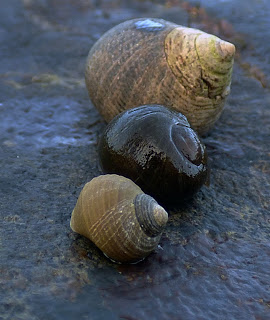
NATURE NEWS Three kinds of periwinkles live in Gulf of Maine Photo by Sue Pike The common periwinkle is considered an invasive non-native species in the Gulf of Maine. A rough periwinkle is at the bottom, smooth periwinkle in the middle and the relatively huge common periwinkle in back By Sue Pike yorkweekly@seacoastonline.com Posted Jul. 19, 2016 at 5:02 PM There is one local snail that I would bet everyone who lives in coastal New England knows and loves: the common periwinkle. What young person hasn’t picked up a periwinkle from the beach and tried to hum it out of its shell? Who doesn’t think that these are cute snails? If you have been to a local beach and your eyes were open, you undoubtedly saw at least one periwinkle — given how many there are out there they are hard to miss. What most people don’t know is that there are three snails that live in the intertidal zone in the Gulf of Maine that go by the name "periwinkle." The one most of...
Black Swallowtail update-eggs hatched!
- Get link
- X
- Other Apps
Nature News Black swallowtail eggs hatched! Young caterpillars-early instars- feeding on fennel. I don't get how such a tiny egg produced such a large caterpillar-8 mm-in such a short time. (photo of egg in previous blog) That white stripe is due to uric acid deposits that are thought to protect the caterpillars from a toxic chemical (furocoumarin) found in their diet. Members of the Umbelliferae family, like fennel, dill and carrots, all of which are host plants for black swallowtail caterpillars, produce furocoumarins as a defense against micro-organisms.
- Get link
- X
- Other Apps
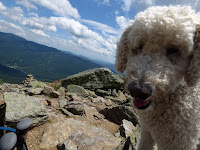
HIKES Alpine Gardens on Mount Washington July 15 2015 Overview: My dog and I wanted to hike up to the Alpine Gardens on Washington (not sure about the dog, but I did). Two easyish ways to get up there are Tuckerman's Ravine Trail up the headwall until you intersect (on the right) the Alpine Garden trail or up Lion Head trail, which intersects with the Alpine Garden trail. I hadn't hiked either the Tuckerman Ravine trail or Lion Head trail with a dog before. I decided to go up Lion Head because I was worried about Glacier (the dog) on that steep part of the headwall that you always hear about people falling off of. I had forgotten about all the steep scrambles on Lion Head (had only previously hiked down it). After scrambling up the steep spots I was worried about Glacier coming down. I am a big baby about scrambles-you won't see me doing anything that involves climbing or cliffs. Glacier turned out to be fine both going up and down but ...
- Get link
- X
- Other Apps
Photo by Sue Pike A black swallowtail caterpillar with extended osmeterium — a bright orange defensive organ that releases foul-smelling chemicals to deter predators. Nature News Baby black swallowtail butterflies are beautiful and common by Sue Pike July 14 2016 We have a large patch of bronze fennel growing out back — this is unfortunate because it can be an aggressive invasive plant and is currently attempting to overrun my blueberry patch, but, on the other hand is good because it is home to a host of baby black swallowtail butterflies. These are one of our most common butterflies - adults are a gorgeous large black butterfly with two rows of yellow spots along the margins of the wings, and characteristic drooping “swallow” tails on the hindwings. Black swallowtail egg photo by Sue Pike The fully grown caterpillars are just as attractive with colorful alternating stripes of greenish-white and black with six ye...